Different Tanks in the Mud Recycling System

Mud system will not work if there are no mud tanks. In the mud recycling system, the tanks are used to store the drilling mud to be a base where the solids control equipment to be installed. Normally, more than one mud tanks
will be used in the oil drilling mud system. For different purpose, the design of the mud tank is different, especially the inner structure of the mud tanks.
There are mainly 3 types of mud tanks recycling tank, intermediate tank and premixing tank. Then what are the different among these 3 types of mud tank?
The recycling tank is where to install the primary shakers and degasser unit, and also the de-sanding and de-silting unit. Each of equipment needs a compartment in the mud tank. As the recycled drilling mud is treated by the solids control equipment one by one. After treatment by each of the equipment, the drilling fluids will be cleaner than before. Thus the drilling fluids cannot be mixed. The wall between two compartments always has an overflow port for balance of the drilling mud in the tank.

Mud-Tank-for-ZJ-50
Mud Tank System

For the tank to install the de-sander and de-silter unit, inner structure of the mud tank would be much complex as there are pipes for centrifugal pump to such the drilling fluids from inside of the tank and transfer to the cyclone for further treatment. Operator has to know which pipe is for de-sander and which pipe is the desilter.
On the mud tanks for installing the solids control equipment on, there always have the walkways and handrails. The walkways provide enough space for the operator to walk around the equipment for operation and maintenance. Intermediate tank is a type buffering tank, part of this tank is for mud recycling, and other parts are used for mud storage. Operators can easily tell how many compartment in this tank.
The premixing tank is used to mix drilling fluids. It always is connected with the jet mixer unit. The mixing pumps suck liquid from mud tank and send liquid back again with added mud materials from the hopper. Thus the pump should be able to suck the drilling mud from anywhere in the mud tank used for mixing and storage.
Therefore, in the mixing tank, there are two groups of pipelines, one for sucking, and the other one is for sending liquid back. Mug agitators and mud guns are always installed on the mixing tank.
Though, the inner structure of the above tanks is different, the outer dimension and design are always the same for purpose of easy transportation and assembling.

40 Feet Water Based Drilling Waste Treatment System

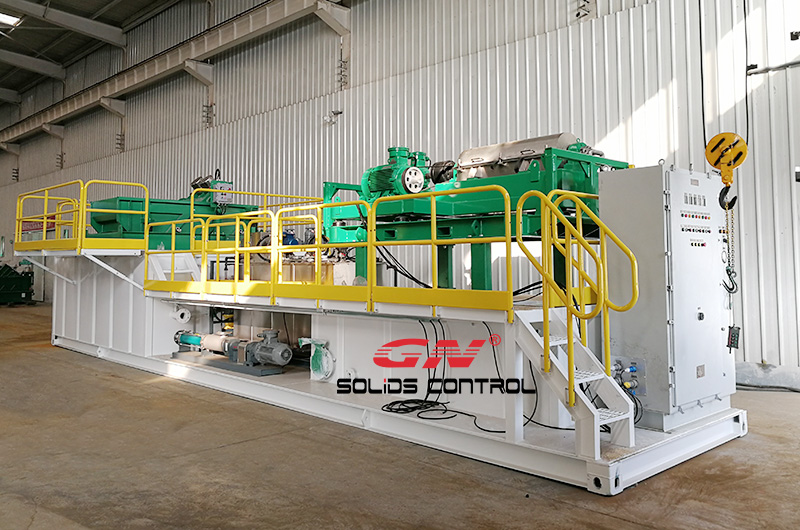
Two weeks ago, GN Solids Control completed one set 40 feet water based drilling waste treatment system that is used for oilfield waste management service. Water based drilling waste is coming from the drilling projects where
use the water based drilling fluids to cool down the drill bit, protect the drilling well wall and take out the drilling cuttings.

The main equipment included in this 40 feet water based drilling waste treatment system are as follows:

1) High G force dryer shakers used to further drying the cuttings discharged from the primary solids control equipment, wide open deck design allows the feeding of waste easily
2) Dosing System for mixing chemicals that will fed to the centrifuge for flocculation process
3) High speed Decanter Centrifuge for liquid and solids separation
4) Mud Tank unit under the shaker to collect the liquid going through the shaker screens
5) Screw Pump transfer the fluids to decanter centrifuge for polishing

water-base-drilling-waste-management-system-2
Drilling Waste Management System

Working diagram of the 40 feet water based drilling waste management system

The drilling waste, always coarse drilling cuttings, was fed to dryer shaker for further drying, and then the screw pump will transfer the drilling fluids with ultra fine solids to the decanter centrifuge (It is also dewatering centrifuge). In the meanwhile, the chemical dosing system mixes polymer, once the polymer solution is cured. The diaphragm pump transfers the polymer to the dewatering centrifuge. The ultra fine solids will get together once meet with the polymer, which will help the centrifuge to separate the solids. The drilling waste management system for separating the ultra solids in waster based drilling fluids is also called dewatering system.

Equipment features of the 40 feet water based drilling waste management system

GN’s high G force dryer shaker has up to 8 G force. with 4 panels composite material screen, the Dryer shaker has an excellent separation and drying performance.
GN high speed decanter centrifuge and feeding screw pump are VFD driven and controlled by PLC. The operators could set the suitable parameters to treat different kinds of drilling fluids.
Besides the drilling waste management system for water based mud, GN also developed the equipment for oil based mud. Even the oily sludge treatment solution is one of GN’s main businesses. GN’s system for drilling waste management has many performance cases that will prove GN equipment quality and availability. This is why customers choose GN Solids Control.

GN Premier Decanter Centrifuge Sent to Latin America for Solids Control

Solids control is one of the main jobs where GN’s centrifuge could be used. Now the latest design of GN decanter centrifuge is the C version with premier configuration.

By the end of this year, 2 of GN premier decanter centrifuge caught up the last ship to Latin America for the solids control job there.  Below are the main features of this premier model.

solids-conrol-centrifuge
Solids Control Decanter Centrifuge
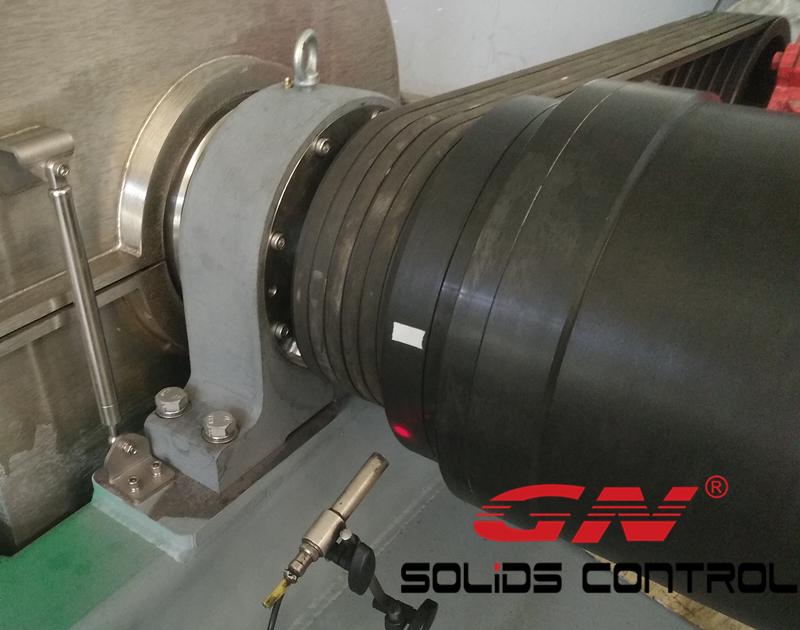
  1. High level material used for the rotating parts. The bowl is the core part of the centrifuge unit; the separation is process when the bowl is rotating. GN uses duplex stainless steel 2205 to make the bowl with centrifugal casting technology. The evenly material distribution ensures the excellent balance performance when rotating. Inside the bowl the scroll is made of SS316L which is much better than the other China suppliers who are using SS304.
  2. All around protection is put on the parts that will bear a lasting friction coming from the solids. The scroll is protected by 4mm thick tungsten carbide tiles that are replaceable for longer lifetime. The outlet port of liquid speeding up cone on the scroll is covered with ceramic liner. The same ceramic liner is also installed at the solids discharge port on the bowl. To prevent the building up of solids in the collection box, the tungsten material scrapers are fixed on the bowl to protect the bowl from wearing.
  3. To ensure the treating capacity, GN makes the slurry feeding direction and solids delivery direction same. This will speed up the solids delivering in the bowl. On the scroll blade, there are several openings allow the liquid passing through for large flow rate.

GN premier decanter centrifuge is also widely used in waste management like the waste cuttings treatment and the oily sludge recovery project. For safety consideration, GN premier decanter centrifuge is equipped with DNV lifting certified skid for transportation.

4 Stages to Get the Oil off the Solid Particles in Oily Sludge

GN now is gradually known as a separation solution provider who not only has the business to provide equipment for drilling cuttings separation from drilling fluids, but also for recovery the oil in the oily sludge. After couple years research, GN developed a 4 stages separation system that could effectively recover the oil from the oily sludge coming from oil based drilling waste, refineries waste and crude oil tank cleaning slurry.
To be frank, GN’s 4-stage oily sludge treatment system is consisting of 4 modules. These 4 modules could be combined freely as per different sludge conditions or outputs. Now let’s see what is the 4-stage oil sludge treatment system.

gn-waste-oil-recovery-system
Waste Oil Recovery System

The first stage is the high G force drying shaker with washing tank. The high G force drying shaker is located on a slurry tank. With a hopper type feeder, the oily sludge could be fed to the shaker easily. Up to 8 G force could effectively remove the coarse material in the sludge. The shaker unit could be equipped with hot water spraying system for better demulsification. To prevent the oily sludge spraying out of the shaker deck, this shaker will have a top cover. Continue reading “4 Stages to Get the Oil off the Solid Particles in Oily Sludge”

Water Recycling System for Tank Cleaning

Recently, GN developed a new product that can be used in the oil tanks cleaning system for the water recycling. Operator use high pressure water, sometimes warm water, to flush the oil storage tank for tank cleaning. This work needs lots of clean water. If the water could be recovered and reused, then a great of money could be saved.

Main part of GN water recycling system
1. Tank cleaning machine – this is a machine that can produce high pressure to drive the water for flushing the inner wall of oil tank. At this time, this unit is outsourced by clients.
2. Clean water buffer tank – this tank is used to store the clean water, also the recycled water is flow back to this tank.
3. Solids remover – the dirty water contents water, oil and solid particles. In order to remove the solids in the mixture, GN designed 2 steps solids remover. First step is de-silter cyclone unit, and the second step is inclined plate clarifier.
4. Pumping system – this system is consisting of pump for water transferring, slurry transferring and settlement sludge discharging pump.
5. Electric control – this unit control all the pumps in the system.

tank-cleaning-system
Water Recycling System

Working principle of tank cleaning water recycling system
1. Clean water will be first fill into the buffer tank; the water transferring pump will feed the water to the high pressure tank cleaning machine for tank flushing.
2. The dirty water is transferred by the second pump to the de-silter cyclone for first step solids removing. A strainer will be installed between the oil tank and pump to filter the large size solids for protection of pump and cyclone.
3. The liquid overflow out of the cyclone will flow into the inclined plate clarifier; the special structure will speed up the solids settlement towards the bottom of the clarifier. The upper layer liquid will overflow back to water buffer tank for reuse.
4. The sludge discharged from the cyclone and bottom of the inclined plate clarifier will be collected in a small cuttings box.

All equipment in GN’s water recycling system for tank cleaning is installed on one skid with length same as 20 feet container. So it could be delivered easily by a flat bed trailer from one site to another.

How the Double-Layers Shale Shaker Works for Mud Recycling

Shale shaker is very common equipment used in the drilling mud recycling system. Its function is the first stage for remove the coarse solids in the drilling mud. Sometimes, we may see the double layers shale shakers are installed in the mud system. Below we would like to share some information on how the double layers shale shaker works in the mud recycling system.
Some mud system may has limitation on the footprint, thus, the operators would like to equip a shale shaker with high treating capacity but compact structure. The double layer shaker no doubt is the ideal choice.

shale-shaker
Shale Shaker

For shale shaker application – when the unit is used as primary shale shaker, it is located at the very beginning of the mud system. As we know, the shale shaker unit has buffer box for mud feeding into the shaker unit. The mud overflow out from the buffer box would flow into the upper shaker screen panels with coarse screen for larger size solids separation. The lower screen panels would be much finer for small solids separation. Double layer shale shaker will have a relative larger capacity; in the meanwhile, it can remove out smaller
solids.
For Mud Cleaner application – Shale shaker can also be used as underflow drying shaker by combining with hydro cyclone unit. This type mud cleaner functioned as both shale shaker and cyclone unit. The lower screen with coarse mesh is for larger solids separation, and the upper screen with fine mesh is for drying the slurry discharged from the cyclone.
GN now has main two models of double layers shale shaker. One is coming from the shaker model of GNZS703. Its deformation GNZS706 double layer is for larger capacity shaker and GNZS705 for mud cleaner unit. The other is GNZS752; it can be upgraded to GNZS753 double layers. These double layer shale shakers are widely used in GN’s compact design mud recycling/de-sanding unit for area limitation project.

GN High Efficiency Mud Mixing Unit

Normally, the drilling mud recycling system is consisting of mud recycling tank skid and mud mixing tank skid. On
the mud recycling tank skid, the solids control equipment like shakers, mud cleaner, and even decanter centrifuge unit will be installed for removing the cuttings and useless solid particles in the drilling fluids. After several times recycling, the useful mud materials will loss together with the cuttings, and then the mud engineer need add new mud materials into the drilling fluids to maintain the proper mud property for the drilling job. The mud mixing unit is the equipment used for adding the mud materials into the fluids.

gn-mud-mixer-unit-1
Mud Mixing Hopper

What is the Function and Principle of the Mud Mixing Unit
The mud mixing unit is always installed at end of the mixing tank. Before starting the drilling, the driller need have sufficient drilling mud to keep a continuous drilling. Thus at the first, the mud mixing unit is used to make the drilling mud by mixing clean water and mud materials. With the drilling going on, once the mud property is not proper for the drilling process, new mud materials like barite or other polymers need to be added into the drilling fluids. The mud mixing unit is sucking the drilling mud from the mixing tank, and then pump the mud together with materials back again into the mixing tank. Normally, the mud agitators would be equipped on the mixing tank for fully blending.

What Components are Included in the Mud Mixing Unit
1. Centrifugal Pump – the inlet of the pump is connected with the mixing tank for sucking the drilling mud from tank. And the outlet is connecting with pipe manifold that will transfer the mud to the hopper unit. As this pump is fixed with the mixing hopper, it is also called mixing pump. This pump is driven by an electric motor via direct shaft connection. By higher efficiency shearing purpose, GN will used belt driving for a shearing pump.

gn-mud-mixer-unit-2
Mixing Hopper Bag Breaker

2. Mud Hopper – GN’s mud hopper is Ventri type connected with the pipe manifold via a T pipe. The mud materials will be added into the hopper and then immediately sucked into the drilling fluids as there is a vacuum produced by the high speed flow. For the hopper, GN uses the material of stainless steel for better anti corrosion performance and long life time. Inside the hopper, there is a bad beaker for quickly adding of powders. On the pipe manifold, there is a pressure gauge for the operator to inspect the working pressure of the mixing pump.
3. Control Panel – GN’s mud mixing unit is equipped with explosion proof control panel for application in Zone 1. The operation of the control is easy for only three buttons on the panel. One on, one off and one for emergency stop, accordingly, the signal lights is installed to reflect the operation.

GN’s mud mixing unit could be installed both at the end of the mixing tank or separately mounted on a small skid. This mud mixing unit can also be designed as a dual hopper dual pump type for larger capacity or in case one of them is broken down.

GN High Configuration Decanter Centrifuge for Prompt Delivery

GN now has over 30 high configuration decanter centrifuge stocked for urgent request and prompt delivery. The decanter centrifuge is normal type equipment used in the drilling fluids recycling system for fine solids separation. As a leading manufacturer of solids control equipment in China, GN always makes the inventory plan for the main equipment that most requested by the clients, like the shakers, decanter centrifuge etc.

What are the basic technical parameters of the decanter centrifuge
1. Size: 14 inch of bowl diameter, 50 inch of bowl length, this length and diameter ration is fine for most of the application
2. Treating Capacity: Max. capacity of 200 GPM with recommended capacity of 132 GPM
3. Speed: Designed Max. speed is up to 3900RPM with recommended normal working speed of 3200 RPM.
4. G Force: 2062 @ working speed 3200 RPM, under this speed, the solids with size larger than 5 microns could be removed out.
5. Gearbox: Torch of 3500 N•M, gear ration 57:1
6. Motor Power: Dual motors as main and auxiliary drive, 37 KW + 11 KW

gn-decanter-centrifuge-inventory
GN Decanter Centrifuge In Stock

What is the configuration the decanter centrifuge in stock
1. Material: Bowl is made of Duplex stainless steel 2205, screw propeller is from SS 316.
2. Bowl Fabrication: Centrifugal Casting technology ensures better material distribution to maximum avoid casting defects.
3. Protection: Screw propeller is protected by the tungsten carbide tiles with uniformly thickness of 4mm, much better than spraying welding 2mm uneven surface. Solid discharge ports are protected by ceramic lining for long life time and less maintenance. Collection box has air spring for easy open and damping close to protect operator.
4. Bear Brand: Genuine SKF bearing for longer and reliable operation
5. Control Panel: Both fixed speed and VFD panels are available as per customers’ requirements. Main electric components are from ABB, Siemens or Schneider.
6. Certificates: CE certificate for main machine, DNV lifting certificate for frame base, ATEX/ IEC Ex certified electric motors and panels are available hazardous area application.

Sufficient inventory is a guarantee for customers’ urgent request and prompt delivery. Now is near the end of the year, and GN is starting the customers profit surrender plan. Call GN no hesitation and you can get a special discount.

GN Centrifuge Modular Package with Telescopic Skid

Decanter centrifuge is a kind of equipment used very often in oil drilling separation process. Like in the drilling mud recycling system, the decanter centrifuge is located after the de-silter cyclone unit for ultra fine solids separation. Some operators will install the decanter centrifuge unit on the mud tank top, while, the decanter centrifuge is not used all the time during the drilling. Thus, some drillers take out the decanter centrifuge from the mud tank system and put it on a skid closed to the mud tank system for easy connection once needed.
Comparing with other solids control equipment in the mud recycling system, the decanter centrifuge is of high cost. This is also one reason it will be taken out from the mud tanks system, always, the driller will find a third party who owns the centrifuge unit to sign the lease agreement.

gn-decanter-centrifuge-skid-modular
GN Decanter Centrifuge with Skip Frame

What Materials Are Included in GN’s Centrifuge Modular Package
1. Decanter centrifuge unit – GN has now 3 main decanter centrifuges for oil industry with bowl size of 14 inch, 18 inch and 22 inch. All these 3 types could be equipped with a PLC smart electric panel for all the remote operation. Both the electric motors and control panels provided are complying with the explosion proof standard. Either for Zone 1 or Zone 2 is available.
2. Electric Control Panel – All the above 3 sizes centrifuge has VFD control panel. The panel would be put on the skid, people could operate on the ground. The panel need is designed positive pressurized needing air blowing into the panel for cooling down and explosion purpose.
3. Telescopic Skid – GN’s telescopic is designed to comply with the DNV lifting certification for widely acceptance. The operator could adjust the skid height as per the actual site condition.
4. Screw Feeding Pump – one unit screw pump is fixing on the skid for feeding the slurry to the decanter centrifuge. This pump is also controlled in the aforementioned control panel.
5. Other Accessories – hose from feeding pump to the decanter centrifuge inlet, solids discharge chute for the centrifuge, liquid discharge port matching flange with nipple and the tools case.

GN’s modular centrifuge package is compact structure for easy location on jobsite. GN can also provide customized centrifuge skid by knowing the installation dimension of Customers’ existing centrifuge unit.

GN Non Oil Drilling Mud Recycling System is Widely Used

The business of today’s GN has been divided mainly into 2 scopes, one is the normal drilling mud recycling, and the other is the waste management including the waste coming from petroleum related and other separation industries. This blog is mainly talking on the drilling mud recycling system that used in non oil drilling industry.
In oil drilling, the drilling depth and safety regulation request large drilling mud storage and more solids control equipment. Thus, the mud recycling system is always equipped with degasser unit and large volume mud tanks.

hdd-mud-recycling-system
HDD Mud Recycling System

Comparing with the mud recycling for oil industry, the unit for non oil drilling is more compact and less equipment needed.

  • Trenchless/No Dig HDD project – The mud recycling system used in this type drilling is matching with a No dig rig. In some project for long distance pipeline and cables laying underground, it is inconvenient to dig an open groove on the ground as that will interrupt the normal traffic. The trenchless is an ideal choice. The mud recycling system for this project is always consisting of 3 stages separation as shale shaker unit, de-sanding and de-silting cyclone.
  • Piling is the main method to install the bridge supporting pillar. A de-sanding unit with a small tank would be enough to remove out the coarse solids from the drilling fluids. The de-sanding unit is a composition of de-sander cyclone and shaker unit that can separate out the solids with size of 40-70 microns. Piling does not request very clean mud; less equipment involved makes the recycling unit for piling is very compact.
  • GN also can manufacture the mud recycling system for tunneling project. For micron tunneling, GN has model available with capacity of 120m3/h, 240m3/h and 500m3/h. For large flow rate request, GN has the mud plant GNMS -3600M with treating capacity of 3600m3/H.
tbm-slurry-separation-plant
Tunneling Mud De-sanding Plant

Besides, GN’s mud recycling system can also be used in water well drilling, coal bed methane exploration, dredge slurry separation and the mining flushing waster cleaning process.